August 2009
Netherland - Joseph O'Neill
Brideshead Revisted - Evelyn Waugh
Do Androids Dream of Electric Sheep? - Phillip K. Dick
My Life in France - Julia Child
The People of Paper - Salvador Plascencia
Fire to Fire - Mark Doty
Foundation - Isaac Asimov
Vile Bodies - Evelyn Waugh
September 2009
Dead In Dallas - Charlaine Harris
Club Dead - Charlaine Harris
The Kite Runner - Khaled Hosseini
What is the What - Dave Eggers
2666 - Roberto Bolano
November 2009
Genesis - Bernard Beckett
December 2009
Animal, Vegetable, Miracle - Barbara Kingsolver
The Guernsey Literary and Potato Peel Pie Society - Mary Ann Shaffer and Annie Barrows
The Mists of Avalon - Marion Zimmer Bradley (re-read)
Franklin and Lucy: Mrs. Rutherford and the Other Remarkable Women in Roosevelt's Life - Joseph E. Persico
January 2010
(LSAT)
February 2010
In Defense of Food - Michael Pollan (4/5)
Zeitoun - Dave Eggers (4/5)
The Ethics of What We Eat: Why Our Food Choices Matter - Peter Singer (3/5)
Working In the Shadows: A Year of Doing the Jobs (Most) Americans Won't Do - Gabriel Thompson (4/5)
March 2010
Cleaving: A Story of Meat, Marriage, and Obsession - Julie Powell (4/5)
Her Fearful Symmetry - Audrey Niffenegger (2/5)
School Lunch Politics - Susan Levine (3/5)
T.S. Eliot: An Imperfect Life - Lyndall Gordon (did not finish)
Marathoning for Mortals - John Bingham and Jenny Hadfield (3/5)
April 2010
Slow Man - J.M. Coetzee (did not finish)
Scarlet Sister Mary - Julia Peterkin (5/5)
May 2010
Never Let Me Go - Kazuo Ishiguro (5/5)
An Artist of the Floating World - Kazuo Ishiguro (4/5)
The Remains of the Day - Kazuo Ishiguro (4/5)
The Help - Kathryn Stockett (3/5)
The Crystal Cave - Mary Stewart (3/5)
The Hollow Hills - Mary Stewart (3/5)
The Last Enchantment - Mary Stewart (3/5)
The Parable of the Sower - Octavia F. Butler (4/5)
June 2010
Five Smooth Stones - Ann Fairbairn (4/5)
Their Eyes Were Watching God - Zora Neale Hurston (re-read) (4/5)
Crossing to Safety - Wallace Stegner (re-read) (4/5)
The Bostonians - Henry James (re-read) (4/5)
July 2010
Anna Karenina - Leo Tolstoy (did not finish)
The Hunger Games - Suzanne Collins (5/5)
The Knife of Never Letting Go - Patrick Ness (4/5)
The Parable of the Talents (did not finish)
Catching Fire - Suzanne Collins (5/5)
The Ask and the Answer - Patrick Ness (5/5)
August 2010
Solar - Ian McEwan (2/5)
Freedom Summer: The Summer that Made Mississippi Burn and Made America A Democracy - Bruce Watson (5/5)
The Magicians - Lev Grossman (3/5)
The Unnamed - Joshua Ferris (5/5)
Oryx and Crake - Margaret Atwood (4/5)
The Routes of Man: How Roads Are Changing the World and the Way We Live Today - Ted Conover (4/5)
Eating Animals - Jonathan Safran Foer (4/5)
September 2010
Mockingjay - Suzanne Collins (3/5)
The Lacuna - Barbara Kingsolver (4/5)
The Immortal Life of Henrietta Lacks - Rebecca Skloot (3.5/5)
The Poisonwood Bible - Barbara Kingsolver (4/5)
Hyperion - Dan Simmons (4.5/5)
October 2010
Monsters of Men - Patrick Ness (5/5)
The Fall of Hyperion - Dan Simmons (unfinished)
(Law School Applications)
November 2010
(Law School Applications)
The Life and Death of the Great American School System - Diane Ravich (4/5)
Feed - M.T. Anderson (2/5)
December 2010
Freedom - Jonathan Franzen (3/5)
January 2011
The Silver Chair - C.S. Lewis (re-read)
Born to Run - Christopher McDougall (5/5)
Oscar Wilde (did not finish)
Norwegian Wood - Haruki Murakami (did not finish)
February 2011
March 2011
The Big Short - Michael Lewis
Just Kids - Patti Smith
Flatland - Edwin F. Abbott
Mansfield Park - Jane Austen
April - June 2011
Fellowship of the Ring - J.R.R. Tolkien (re-read)
The Two Towers - J.R.R. Tolkien (re-read)
Game of Thrones - George R. R. Martin
Storm of Swords - George R. R. Martin
Clash of Kings - George R. R. Martin
Feast for Crows - George R. R. Martin
Room - Emma Donoghue
The Road - Cormac McCarthy
World War Z - An Oral History of the Zombie War - Max Brooks
Bossypants - Tina Fey
Brideshead Revisited (re-read)
July 2011
Planet Law School, II - Atticus Falcon
Harry Potter and the Deathly Hallows - J.K. Rowling (re-read)
Dance with Dragons - George R.R. Martin
King of Torts - John Grisham
Law School Confidential - Robert H. Miller
Never Let Me Go (re-read) - Kazuo Ishiguro
August 2011
Ender's Game - Orson Scott Card
Speaker for the Dead - Orson Scott Card
Wolf Hall - Hilary Mantel
Bleak House (re-read) - Charles Dickens
September 2011
Falling Man - Don DeLillo
The List
The Finkler Question - Howard Jacobson (Booker Prize 2010)
C - Tom McCarthy
The Lost Books of the Odysessey - Zachary Mason
A Visit From the Goon Squad - Jennifer Egan
Super Sad True Love Story - Gary Shteyngart
Let the Great World Spin - Colum McCann (NBA 2009)
Remarkable Creatures: Epic Adventures in the Search for the Origins of Species - Sean B. Carroll (NBA 2009 )
Transcendental Studies: A Trilogy - Keith Waldrop (NBA 2009)
Claudette Colvin: Twice Toward Justice - Phillip Hoose (NBA 2009)
American Salvage - Bonnie Jo Campbell (NBA 2009)
A Happy Marriage - Raphael Iglesias
Portrait of a Lady - Henry James (re-read)
My Empire of Dirt - Manny Howard
Food Politics - Marion Nestle
The Crisis of Islamic Civilization - Dr. Ali A. Allawi
Independence Days: A Guide to Sustainable Food Storage and Presentation - Sharon Astyk
Food, Inc.: Mendel to Monsanto - Peter Pringle
Let Them Eat Junk: How Capitalism Creates Hunger and Obesity
Das Kapital - Karl Marx
As Is - James Galvin
The Penelopiad - Margaret Atwood
Ender's Game - Orson Scott Card
Saturday - Ian McEwan
Inherent Vice - Thomas Pynchon
Floodmarkers - Nic Brown
Home - Marilynne Robinson
The Bean Trees - Barbara Kingsolver
The Summer Before the Dark - Doris Lessing
The White Man's Burden – William Easterly
Getting Off: Pornography and the End of Masculinity – Robert Jensen
Perfect Girls, Starving Daughters: The Frightening New Normalcy of Hating Your Body – Courtney E. Martin
The Oxford History of the Biblical World – Michael D. Coogan
The Plot Against America – Philip Roth
The Invisible Cure: Africa, the West, and the Fight Against Aids – Helen Epstein
The Enchantress of Florence – Salmon Rushdie
Angler: The Cheney Vice Presidency – Barton Gellman
The Post-American War – Fareed Zakaria
What the Dead Know – Laura Lippman
September 5, 2010

September 1, 2010
Mockingjay - Suzanne Collins
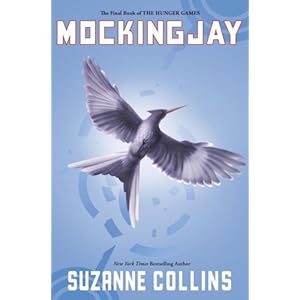 Mockingjay wasn't quite what I expected from the final third of this admittedly thrilling young adult fantasy trilogy. The first two books walked a delicate line between the somewhat conventional and the surprisingly fresh, or - maybe more pertinent - between the commercial and the avant garde. They were age appropriate and wholly familiar in their tropes, yet at the same time flirted with meta-narrative, containing nuanced examinations of friendship, loyalty, and attraction. They were satisfying on nearly every level.
Mockingjay is not nearly so satisfying, but that doesn't necessarily make it a bad book. In fact, I would go so far as to say that it's probably a better book, both for its refusal to pander to the reader's expectations and for its more willing embrace of the less commercial aspects of its predecessors. I came to Mockingjay (as I did with the Hunger Games trilogy in general) hoping to be titillated by good dystopic world building and pre-teen romance, and while the world building and romance are still there in flashes, Collins seems to have another goal in mind as she wraps up her trilogy.
The main characters are back: Katniss, still surly and fiercely independent, resisting the attempts of the rebels to make her their "Mockingjay," the symbol of the rebellion; her childhood friend Gale; other Hunger Games alumnae; and of course the irrepressible Haymitch, Katniss' Hunger Games mentor. The situation has changed, however - the Hunger Games have broken and given way to full-on rebellion. Katniss and her crew are housed in the long-forgotten District 13, a technologically advanced and draconian society, which is the breeding ground for the rebellion rising in the other districts. And while the power brokers from the previous books are off plotting in the distant Capitol, Collins gives us a whole new set of politicians and bureaucrats to mistrust - President Coin, of District 13, foremost among them.
Mockingjay is hung on a much looser frame than its predecessors. Kanitss must become the Mockingjay; the rebellion must go forward; they must rescue Peeta and the other captured Hunger Games tributes; they must advance on the Capitol and assassinate evil President Snow. It's much less a plot and much more a collection of sequential events, clustered around Katniss. To be honest, it's a disaster of a plot - linear and yet schizophrenic, dependent much less on a series of causes and effects and much more on some predetermined sequence of events. The previous books allow Katniss some agency once she enters the arenas of the Hunger Games; Mockingjay removes it from her almost completely. Although she manages to wrest some control during the fleeting scenes of battle scattered throughout the novel, and especially towards the end, Katniss is oppressively controlled through most of the novel, and it is this lack of agency that affects both the character and the plot.
Mockingjay could be a hot mess, a scatter-brained conclusion to a previously tight and controlled series; it could also be genius.
The more I think about it, the more convinced I am that Collins, with this novel, has created an affecting picture of post-traumatic stress disorder and its effects. There's not a single character who isn't deeply scarred by the ordeals faced in the Hunger Games, not the least of whom is Katniss, who moves through much of the book in a kind of rage-induced haze. When I found myself concerned that Collins seemed to be skirting over the more essential actions of the rebellion, giving us reports without putting us in the action, so to speak, I realized that we are, like it or not, pretty firmly stuck in Katniss' point of view, and the alienation the saturates the novel is simply a manifestation of Katniss' own alienation. Katniss is, in effect, Harry Potter if Harry Potter had been written in absolute truthfulness - by this third novel, she is irreparably damaged by her ordeals.
Mockingjay is anarchic, distrustful, violent, and deeply unsettling. Katniss does get the boy in the end (though I won't say which one), but the "getting" is complicated and dogged with memories of trauma. It's ultimately unfulfilling, but I'm pretty sure that's beyond the point. Mockingjay wants to do more than fulfill.
August 12, 2010
The Magicians - Lev Grossman
 I'm not sure I quite get Lev Grossman's newest book, The Magicians. On the one hand, it's a genre-bending, sensitively observed treatment of a young man's life at a school for magic; on the other, it's a problematic and schitzophrenic novel that suffers from too much abstract framework and not enough attention to narrative.
The first half of the book is really exquisite, crack for grown-ups who still lust after books of the Harry Potter ilk - well-written tomes detailing lives more adventurous and fantastical than our own. It's written for those of us who grew up, as Grossman must have, reading Lord of the Rings and C.S. Lewis' Narnia books over and over, imbibing every detail and wishing that we too could step into Middle Earth, or Narnia, or through the looking glass, just once. And that's Quentin, the brilliant main character who at 17, seemingly set for a life of average brilliance at a Princeton or a Yale, instead finds himself set up at an elite school for magic in upstate New York. He's not a particularly happy young guy - Grossman adeptly describes him as walking with a slight stoop to his shoulders, as if expecting the world to come crashing down on him at any moment. And that, I think, is the root and soul of this wistful novel: how, in the process of growing up, we struggle to adapt and cope with what the world throws us, and how we either manage to survive and thrive, or crash and fizzle, or - worse than anything else - steel ourselves against the mania of life and move through the hours in a sort of glum haze.
The first half of the novel captures this theme beautifully, in scenes evocative of English boarding school novels. Though set in a backdrop of magical discovery, the Brakesbill sections are more interested in Quentin's journey of self-discovery, and they amble along with little else to propel them but impending graduation (after four years) and the promise of characters' growth. And, because of the delicacy of Grossman's writing and the detail he devotes to the magical world's dark and complex philosophy, these scenes largely work. At times, they feel rushed and truncated (four years in two hundred pages seems a bit of a stretch), but when Grossman drops from expository narrative into direct action of a scene, the magic really crackles.
The novel takes a bizarre turn about 2/3 of the way in. Newly graduated, Quentin and his girlfriend move to Manhatten to embark on the hedonism of young magicians, who have all the money and power in the world but no direction. Some life lessons are learned, and some hearts are broken, until an old friend from school shows up with the key to help them all enter the fictional fairytale land of their favorite childhood books. At this point, though still steeped in a kind of emotional realism, the novel begins to feel much more like allegory. The group of young magicians does indeed make it into the other world in search of a tidy quest, like the ones they remember from the books, only to find themselves, in the end, embroiled in a darker, more vicious battle than they had ever imagined, one that will tear them apart and affect the remainder of their lives to come.
The novel wavers through these scenes, and they never seem fully allegorical nor fully a part of the previous sections in the novel. The tones of alienation and abandonment are still present, but they're buried under the bizarre, still rather rushed, adventures of the characters. It's hard to know whether Grossman is participating in a send up of fictional lands, particularly Narnia, or whether he's trying to create his own contemporary version; regardless, the purpose is unclear, and these scenes feel flat and forced. When the character encounter some mild action and violence, Grossman seems unsure how to handle it, and the resulting effect is anticlimactic and, worse, boring.
The novel itself is anticlimactic, fizzling out rather than coming to any kind of satisfactory ending. It's also ambivalent, as Quentin wavers over what to do with his wrecked life, and as he trys to decide what will fulfill him.
But perhaps that's the point. Grossman, particularly in the beginning chapters, is an adept story-teller and seems in charge of his material. I have a hard time believing that he would allow the second half of the novel to go so wildly off the rails. Rather, I wonder if the trip through the land of Fillory isn't more of his meditation on coming-of-age, simply shifted into a different format. And the more I contemplate the ending, in which Quentin steps out the window of his high rise office building to join the magicians who have come fetch him, I wonder if it isn't simply an allegorical treatment for suicide. If so, I appreciate what Grossman is trying to do, but I can't help feeling incredibly unsatisfied, led down a path only to be disappointed by what was at the end.
March 2, 2010
The Ethics of What We Eat - Peter Singer

True, I've been piling on the food reading these days. This is a fair assessment. But, honestly, the more I read about food, the more I want to read about food. This led me to Peter Singer, philosopher, ethicist, and author of the seminal animal rights text, Animal Liberation, who a few years back published The Ethics of What We Eat, his own journey through America's industrial food system and his search for how to establish an ethics for eating.
There are lots of similarities between Singer's book and Michael Pollan's The Omnivore's Dilemma. Singer relies heavily on Pollan's work and cites him extensively; more obviously, Singer borrows Pollan's idea of tracking the food history of several different meals. While Pollan's meals are constructed by him, using three different "food systems," Singer looks at the food choices of three different families, each of which relies on a different set of principles in purchasing and eating food. He selects families that are pretty clear-cut representatives of different American sub-cultures - the meat-eating family that buys most of their food at Wal-Mart, the semi-vegetarian family who buys much of their food at Whole Foods and Trader Joe's, and the vegan family who buys most of their food through alternative avenues. He examines their food choices by looking at where the food comes from - the reality behind the labels - and tries to create an ethical hierarchy of the three family's choices.
Singer's book is oddly organized, by which I mean it's not, really. Rather than hanging the whole book on three evenly divided sections, Singer chooses instead to address issues as they crop up organically. So when it's time for a chapter on poultry production, there's a chapter on poultry production, and so on. The last few chapters are the most interesting, as Singer moves beyond the facts and label-scouting that have become pretty familiar in food-writing, and shifts into a more philosophical tone. It's fascinating to watch a "real" ethicist evaluate food choices and to see the process behind which Singer organizes his ethical hierarchy. Of course, as is obligatory, Singer ends his book with a chapter on what we should eat. (At this point, yawn.)
The Ethics of What We Eat is another good entry into the canon of intellectual food writing, and I recommend it for anyone interested in an ethicist's perspective on the whole food movement. (You get the added benefit that it's by Peter Singer, for crissakes - the man's a legend.) So if you're making a list of foodie books, add this one to it.
There are lots of similarities between Singer's book and Michael Pollan's The Omnivore's Dilemma. Singer relies heavily on Pollan's work and cites him extensively; more obviously, Singer borrows Pollan's idea of tracking the food history of several different meals. While Pollan's meals are constructed by him, using three different "food systems," Singer looks at the food choices of three different families, each of which relies on a different set of principles in purchasing and eating food. He selects families that are pretty clear-cut representatives of different American sub-cultures - the meat-eating family that buys most of their food at Wal-Mart, the semi-vegetarian family who buys much of their food at Whole Foods and Trader Joe's, and the vegan family who buys most of their food through alternative avenues. He examines their food choices by looking at where the food comes from - the reality behind the labels - and tries to create an ethical hierarchy of the three family's choices.
Singer's book is oddly organized, by which I mean it's not, really. Rather than hanging the whole book on three evenly divided sections, Singer chooses instead to address issues as they crop up organically. So when it's time for a chapter on poultry production, there's a chapter on poultry production, and so on. The last few chapters are the most interesting, as Singer moves beyond the facts and label-scouting that have become pretty familiar in food-writing, and shifts into a more philosophical tone. It's fascinating to watch a "real" ethicist evaluate food choices and to see the process behind which Singer organizes his ethical hierarchy. Of course, as is obligatory, Singer ends his book with a chapter on what we should eat. (At this point, yawn.)
The Ethics of What We Eat is another good entry into the canon of intellectual food writing, and I recommend it for anyone interested in an ethicist's perspective on the whole food movement. (You get the added benefit that it's by Peter Singer, for crissakes - the man's a legend.) So if you're making a list of foodie books, add this one to it.
February 25, 2010
Zeitoun - Dave Eggers

Some of you may recall my thoughts on Dave Eggers' What is the What, his nonfiction novel about one of the Lost Boys of Sudan, and his first long-form foray into writing the accounts of human rights victims. (See Eggers' Voice of Witness foundation for more information on this project.) Zeitoun is his second book along this vein, although it's billed as strict nonfiction, presumably because Eggers doesn't need as much novelistic license in recreating his main character's backstory.
[Disclaimer: Before writing this, I broke one of my cardinal rules and read a couple reviews of Zeitoun, so whatever I say will most likely be tinted with shades of other folks' opinions. I can't help it. For some reason, that's how I roll. Onward.]
Zeitoun's main character is Abdulraman Zeitoun, New Orleans resident, father of four, and small-business owner (he's a paint contracter and small-time landlord, to be precise). He's Syrian-American, an American citizen born and raised in Syria in a strong, sea-faring family; he's married to an American woman, Kathy, who helps him run his business; both devout Muslims, they have raised their children to be observant. The narrative describes the life of the Zeitoun family in the days leading up to Hurricane Katrina, during the storm, and in the subsequent weeks. Obviously, their perspective - that of Zeitoun and Kathy - is unique: not only are they invested residents of New Orleans, one of whom (Zeitoun) refused to leave during Katrina, but they are also members of the most marginalized culture in American society following 9/11. As their story unfolds, both Kathy and Zeitoun undergo experiences that are both indelible records of the horrors carried out after Katrina and microcosms of the paranoia and xenophobia that saturated the United States in the early, post-9/11 years of the Bush administration.
What is the What was a novel - a novel about a real person, but a novel all the same. Zeitoun, on the other hand, is chillingly, achingly real. Eggers writes with the uncluttered clarity of a journalist, and I appreciated all the more the submission of his own ego to the larger arc of the story. Even more importantly, Eggers refuses to make polemic a story that so easily could be used as an example in a larger critique of the Bush-era human rights violations; rather, Zeitoun is rigorously controlled, focused on the details and import of the Zeitouns' experience. Their experience speaks for itself, and Eggers is smart enough to know it.
It's similar, in many ways, to Tom McCarthy's 2008 film, The Visitor, which deals with similar themes but refuses to expound on them directly. Rather, both Eggers and McCarthy let their characters be real, breathing, living human people (which is always difficult, even in Eggers case, in which the characters are real people), rather than ideological mouthpieces.
Sure, there were more than a few moments when I had to remind myself that there was an author shaping the story, that our belief in the story is wholly contingent upon our trust in Eggers as a reliable author. After a while, however, I decided that Eggers (and, in fact, the whole Zeitoun family) has been nothing but transparent about their ordeal (you can read more about their lives on the Zeitoun foundation's website), and that it would be an insult not to accept their story as truthful.
The book is incredibly poweful. I can't tell you the number of times I stopped reading, looked up, and said, "Oh, my god," aloud. And I can verify that I spent at least an afternoon exploring strategies to extract myself from any kind of government participation. And I cried a couple of times.
So go read it... if you dare.
February 23, 2010
In Defense of Food - Michael Pollan
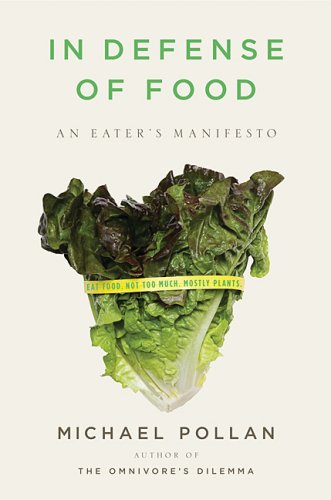
Those of you who know me know my obsession with food and food writing. Among my favorite food writers are Mark Bittman, author of the inimitable How to Cook Everything Vegetarian (I should write a review of that!), and Michael Pollan, author of The Omnivore's Dilemma. Love them both.
Recently, I picked up another of Pollan's books, In Defense of Food, a shorter read than The Omnivore's Dilemma and with a more practical focus. Although it draws on many of the same principles Pollan espoused in Omnivore, In Defense of Food goes further in laying down some simple rules for eating in our culture and effective strategies for "opting out" of what Pollan calls "the Western diet."
Pollan begins with a very, very simple maxim: Eat food. Not too much. Mostly plants. While the first section of his book is dedicated to breaking down the problems with the Western diet, with our obsession with nutrition (what Pollan calls "nutritionism," in an effort to bring to light its ideological concerns), and with the power the food industry has over the Western consumer, the second section is dedicated to breaking down Pollan's initial maxim into practical componants. For instance, Pollan explains what he means by his injunction to "eat food" - what is "food"? Don't we eat it already? What isn't food? How do we tell food from not-food? And so on.
He gives practical, simple rules to guide us in how not to eat too much. He provides advice on why leafy plants are so very good for the body, and how the Western diet tends to eschew them in favor of meats and seeds. He points out the dearth of food culture in American society and encourages the development of one. He defends the idea of quality over quantity.
In short, In Defense of Food is sort of a primer to the wholistic view of eating and food that is championed by folks like Pollan, Bittman, and others - the idea that we don't really need "nutrition science" to tell us how to eat, but that we do need to step outside the current paradigm and re-align our way of thinking about food. It's a great book - simply and clearly written, and I particularly appreciate that Pollan spends a great deal of time examining the various nutritional studies that have been done and detailing their strengths and weaknesses. This kind of work is very needed.
In Defense of Food reiterated the themes and principals that I'd already encountered in The Omnivore's Dilemma, the documentary, Food, Inc., and Animal, Vegetable, Miracle (to say nothing of the amount of food journalism I've consumed this year), and so much of it was a refresher course for me. Even so, I found it to be one of the most comprehensive and well-grounded of the wholistic food literature out there, and it's a book that I'll be forcing on all my friends and relatives in the near future.
You think I won't? Watch me.
January 8, 2010
Franklin & Lucy: Mrs. Rutherford and the Other Remarkable Women in Roosevelt's Life - Joseph E. Persico

It was, in fact, a surprisingly easy and engrossing read. Though Persico's tone and treatment are both remarkably balanced, the subject matter itself is gossip-mag fodder. Obvs, fans of ER and FDR will no doubt be well familiar with the role that Lucy Mercer Rutherford played in FDR's life; however, as a relative newcomer to the genre ("Roosevelt Lit"), there was much I didn't know about FDR's primary mistress. This was the woman who shook up ER and FDR's marriage in 1918, and though supposedly banished, continued her friendship and relationship with FDR afterward, through her marriage and his bout with polio, through his terms as President, and who was with him the day of his death in 1945. Fascinating stuff.
In addition, I was pleased to find that Persico also spent a great deal of time discussing FDR's relationship with ER, as well as with his other "mistresses" - Missy LeHand, whose story is both heartwarming and tragic, Dorothy Schiff, and others. It's revealing of a different time when a man who held the Presidency for 12 years could have so many close relationships with women and yet not have it become the scandel it would most certainly become today. It wasn't that these relationships were entirely secret - a great deal of people were "in the know" - but there was much more discretion, it seemed, surrounding the Presidency that allowed FDR this kind of freedom.
Those who are more familiar with Roosevelt Lit might not find much new material - from what I hear, Persico's book is interesting more for its treatment than for any astonishing revelations. Even so, I found it an excellent entry-point into the fascinating lives of FDR and ER.
January 4, 2010
The Guernsey Literary and Potato Peel Pie Society - Mary Ann Shaffer and Annie Barrows
I am, shockingly, behind on reviews. In an attempt to catch up, here's something I read the weekend after Christmas.


My mom lent me The Guernsey Literary and Potato Peel Pie Society after she read it in a book club and enjoyed it. Though I'm not usually one for books with cutesy titles (I've avoided the series "The No. 1 Ladies' Detective Agency" largely because of the name), it was brief and promised to be light, and that's really what I needed in the weekend at home after a full Christmas.
As an initial matter, the authorship of this novel confuses me. Ostensibly, Barrows took over the manuscript after Shaffer couldn't complete it because of health issues; whether Shaffer eventually passed away from her health problems is hinted at but unclear. What's even more unclear is what role each woman had in shaping the manuscript, and so it's difficult to think of this book as the work of an author. Given its subject matter and style, I'm more inclined to think of it as the joint product of a publishing company, editor, and multiple authors. The thought that a book was written in conference diminishes somewhat the joy of experiencing it (at least to me); in this case, it also explains many of the novel's missteps.
Guernsey (I will dispense with the unwieldy title) is a novel in letters, which largely revolve around the central character Juliet Ashton, a newly minted best-selling British author living in 1946 England - less than a year after WWII had ended. The correspondence jumps between Juliet and a host of friends and relatives: her editor, sister-in-law, suitor(s), and other chums. A bulk of the correspondence, however, is devoted to a new acquiantance, Dawsey Adams, a farmer on the channel island of Guernsey, and with his fellow islanders, who describe to Juliet the trials they suffered under the German occupation of their island and the "literary society" (of sorts) they formed in response.
Of course the novel isn't really about this literary society, which is simply a means by which Juliet enters into the friendship of these island people; instead, it's about Juliet's slow mid-life, post-war re-awakening, and about the friendships that sustain us through difficult times.
Treacly subject matter, to be sure. Fortunately, the authors have imbued the characters (seen only in their letters) with distinct personalities and styles, and being essentially "small-town folk," most of the characters are quaintly colorful. The writing is lively and polished, and the novel moves seamlessly, easily through the progression of letters. It's quick and easy to read, and the characters are easy to love.
The novel is hampered partially by its structure. Story-in-letters is a useful technique, but I'm not sure it's enough to sustain a novel without suspending some serious disbelief. Obviously, the authors realized that developing back story and character within the context of letters was a tricky task, and they handle it as best as they are able - this essential information is inserted organically enough, as long as you ignore the fact that even the newsy letters of old rarely contained the level of detail and forthcoming that exist in Guernsey's letters. Additionally, the characters are so engaging that after a while you really wish to break free from the letters and see the characters actually doing something. The distinctions between letters and narrative are subtle, but there is always the sense that you are reading letters, and the immersion capable with a traditional third (or first) person narrative is impossible to sustain.
It's a sweet novel, and a delight, but it's little else. Tragedies are alluded to and drama is skirted with, but the novel insists on staying firmly inside beams of sunshine. There is a darkness in many of the characters, and there is definite tragedy in the very recent events of World War II, and I often found myself wishing that the authors had been more intent upon showing some of that darkness. At the same time, however, I can't shake the feeling that this book was manufactured specifically for the book-club set, and that grappling with darkness just wasn't the point.
December 1, 2009
Animal, Vegetable, Miracle - Barbara Kingsolver
I've wanted to write about Animal, Vegetable, Miracle, by Barbara Kingsolver, ever since I first read it a year ago. I read a rash of books at the end of last year that had some impact on me, but of them all, Kingsolver's book really changed my life the most. And when the weather turned cool again this fall, and the days became darker, I found myself wanting to read it again, which is not something I typically do, especially with a book read as recently as last year. But Animal, Vegetable, Miracle is that good.
It fits neatly into a sub-genre of memoir that has gained popularity in recent years: the "do-something-for-a-year-and-then-write-about-it" memoir. (No Impact Man and Julie and Julia come to mind as recently high profile examples of this genre.) Publishers keep churning these babies out, presumably because people like reading about such neat, ostensibly life-changing experiments. And, of course, that is what these books purport to contain; after all, if such experiments had not been life-changing, it wouldn't be worth much to write a book about it, would it?
So this is where I filed Animal, Vegetable, Miracle when I idly picked it up off the "Notable Paperbacks" table at the bookstore, and then idly took it home, and then idly began reading the first chapter. Kingsolver's take on the genre involves her family – a husband and two daughters – who move from their desert home in Tuscan, Arizona, to a family farm in the rolling hills of southern Virginia. Both Kingsolver and her husband grew up in this area of the country, and both feel that it's a return to their roots; for their daughters, both desert-born and raised, the move is quite a change, but it's also an adventure. Kingsolver takes this move as an opportunity, a move away the Tuscan food culture, in which food and water are imported from elsewhere, to a place where food can be (and is) grown all around her. The goal: for a year, eat only the food she and her family can grow for themselves or buy from someone they know.
Like all books of this sort, much of the beginning is devoted to explaining the "rules," and as with all these experiments, there are the inevitable concessions that must be made. In Kingsolver's case, these exceptions involve wheat milled in her county but grown elsewhere, and a single splurge item for each family member: coffee for her husband, spices for her, dried fruit for her children. Kingsolver also spends a great deal of time in the first chapters to detailing her family's reasons behind adopting this kind of lifestyle, and although her reasoning is sound, it's not entirely groundbreaking. Needless to say, the first chapters are something of an appetizer, a place where we get to know the dramatis personae and the location (which is a character in its own right, alongside Kingsolver and her family).
It's when Kingsolver begins to detail her year of eating locally that the narrative really unfolds. It's loosely structured around what Kingsolver calls the "vegetannual," a year in terms of crop growth, beginning with the first shoots of asparagus in early spring and continuing right through the harvesting of pumpkins and potatoes in the fall. Kingsolver refuses to adhere to a rigid structure, and each chapter blooms organically, centered around a different aspect of the successive seasons. One chapter is devoted to asparagus and morels, another to the mid-summer quiet period (during which the adults take a foodie vacation to Italy and encounter marvels), another to canning tomatoes, which occupies much of August. One of my favorite chapters involves eight-year-old Lily's egg business and details the careful planning for and arrival of the spring chickens, as well as Lily's near-obsessive devotion to poultry. Another discusses the intricacies of making homemade cheese.
The structure is where the implicit theme of the book reveals itself—though the expressed goal is to eat locally, it quickly becomes clear that eating locally, for Kingsolver and her family, also means eating seasonally. And it is the seasons, the "vegetannual," and the yearly observation of crops grown and eaten in their proper time that truly obsesses Kingsolver and makes her book so much more than a simple tract on eating organically. For eating seasonally means accepting both bounty and scarcity, of learning to do without, of learning to preserve, and of learning to accept that there is a time for everything. These are the lessons that Animal, Vegetable, Miracle really contains, lessons that are, by their very nature, so antithetical to our contemporary habits of wantonness and waste.
It doesn't hurt that Kingsolver is an adept writer by profession, and her proverbs and anecdotes are sprinkled with plenty of good humor and lyricism. At times, her writing drifts dangerously close to a treacly, worshipful sentimentality, but in general she retains good control of her lyrical monster and renders, on the whole, not only an important and timely memoir, but a well-written one as well.
The packaging of the book is one of its greatest strengths. Not simply a memoir by Kingsolver, it's also packed with text inserts authored by her husband, Stephen L. Hopp, describing the political background to many of the concepts mentioned. In addition, each chapter is followed by a short essay by the oldest daughter, Camille (eighteen when the book was written), detailing her perspective, and offering seasonal recipes and meal plans to accompany the content in the chapter. Finally, there is also a searchable companion website, which contains many of the recipes found in the book, along with other tips and tidbits.
For someone who grew up knowing little to nothing about growing, preserving, and cooking my own food, Animal, Vegetable, Miracle was an eye-opener and a life-changer. It showed me the importance of our food choices and instilled in me a much more passionate relationship with food (and the culture that surrounds it) than I ever had before. If I could, I would give this book to everyone I know.
November 2, 2009
Genesis - Bernard Beckett

Genesis, then, a novel by Bernard Beckett, is an appealing product from the outset: a small, slim hardbacked volume, no more than 150 pages and entirely unpretentious. The cover art is incredibly compelling - I must have spent a combined ten minutes staring at the front cover alone. I generally don't care for hardbacks, but Genesis is neither bulky nor weighty, and opened beautifully from the first page. It was, in a word, excellent airplane reading.
Genesis has been sitting on my shelf for the last month, since I took a break from reading to begin studying for the LSAT. I nabbed it off an Amazon Best-Of reading list because the blurb grabbed my interest; by the time I got around to reading it yesterday, however, I had forgotten whatever the blurb said that interested me. I came to Genesis with little idea of what I was getting into (per the usual, I didn't read the flaps before beginning).
It's a novel of rigid structure, spanning the four hours and three intermediate breaks of a student's oral examination for entrance into the Academy. Throughout the student's recitation of her subject of expertise (an important figure in her society's formation), we learn bits and pieces of the recent past, as well as the manner in which the contemporary society came into being. Though initially such a tight structure - involving, primarily, the Examiners' questions and the student's answers - might seem incredibly limiting, Beckett pushes it in unexpected ways, splicing the examination dialogue with bits of long narrative storytelling (on the part of the student), some carefully controlled flashback, and well-constructed scenes of the past, shown by hologram in the examination room. This surprising flexibility keeps the structure from becoming tedious, and it enables the story to gather speed quickly. Before we know it, we're engrossed in highly philosophic conversations between two historical figures and rushing towards an end that, as it unfolds, is in turns both satisfying and grotesque.
It's an excellent, quick, engrossing novel. Beckett exhibits excellent control over both his story and his style, the latter of which is spare and ironic, mercifully free of the clumsiness that clutters so much sci fi writing. It's not an entirely original concept, and the "surprise!" ending will not be such a surprise if you follow the writing closely, but the whole thing is so well-handled and so tightly executed that I found myself deeply impressed.
A suggestion: best read while listening to The Fountain's soundtrack.
September 25, 2009
Ursa Major - Third Eye Blind

That is what Ursa Major feels like.
I know basically nothing about music other than how to say, "I like this" or "I hate that" or "this sounds like that," so I don't particularly consider myself a music critic. That said, Ursa Major sounds like vintage Third Eye Blind, with the same guitar sounds we all loved back at the end of the '90s and little development out of their original favorite chords. Ursa Major isn't experimental by any stretch of the imagination; it isn't even a new direction for the band. The tracks all sound vaguely familiar, mostly because we've heard bits and pieces of them before. Jenkins is operating with all the same ingredients, but he's just mixing them around in different ways... Ursa Major, more than any other Third Eye Blind album preceding it, evokes its predecessors with every tracks. You'll hear a little bit of Blue, more than a litle bit of Out of the Vein, and the faintest whiff of the debut album.
This musical familiarity isn't a bad thing (see above) because I've always liked Third Eye Blind's sound. It's nice to know that you can buy a 3eb album and know exactly what you're getting. However, if Third Eye Blind's hasn't really branched out or developed musically since Blue, neither have they developed lyrically. I appreciated Jenkins' writing when I was a kid, but something has changed over the last twelve years: I've grown up. And Jenkins, despite his increasingly pummeled appearence, hasn't.
Jenkins' lyrics work when they're honest... his writing may not contain much lyricism, but at his best he manages to evoke a raw brutality that contrasts well with the nearly-fluffy pop rock chords. (Who can forget "Slow Motion," from Blue?) In Ursa Major, he follows through with some great lines: "Where's my super secret stupid fucking pocket where I left my bungalow keys," (from "Summer Town") and "Sometimes a blowjob's not enough/Why can't you play/A little less rough" (from "Why Can't You Be"). Still, his little-kid petulance can veer into the precious, when he asks, in "Why Can't You Be," "Why can't you be like my water pick shower massager?" I don't mind when singers like John Darnielle work in that medium (see "International Small Arms Traffic Blues" from Talahassee), but Darnielle's irony makes it work. What makes Jenkins' lyrics like these flop is his god-awful earnestness.
This earnestness is at its worst when trying to philosophize or, tragically, politicize... Jenkins has the subtlety of a sixteen year old who's just discovered the world isn't all sunshine and flowers. "About To Break," not a bad track, really, showcases some of the worst writing: "For the social worker at the needle exchange/For the soft medicated and the hard deranged/For the lesbians at the bakery/Saying, 'Do you really hate me?'"
Never before have I bought a Third Eye Blind album and actively hated a track, but I guess there's a first time for everything: "One in Ten" is really dreadful. Take, for instance, this lyrical gem: "No chance I could be her boyfriend/I'm trying to flip butch girls again/We could see what life pretends/And why don't I still call a friend?" Musically, it's inoffensive (aside from being resoundingly dull), but the tale about trying to flip a lesbian seems straight out of a college fratboy playbook. Jenkins is in his forties, and this song made me want to tell him to grow up.
Ok, all that aside, Ursa Major is still pretty great. After all, it's Third Eye Blind, right? And when you've been a fan as long as I have, lyrical miscalculations and musical repetition isn't enough to keep you from enjoying an album. Like all 3eb albums, it's great for riding in the car with the windows down... I think maybe I'll just skip Track 5.
September 17, 2009
What is the What - Dave Eggers
I am almost at a loss to know how to describe Dave Eggers' novel, What is the What. My recent habit in reading books has been to approach them with as little context as possible, in order that I might have the purest initial reaction (later, of course, I read countless reviews to find out how my reaction meshes with the general dialogue about a book). With What is the What, I did just that - my initial thoughts upon beginning the novel centered upon the author (thoughts described in some detail here) and not at all upon the story.
Specifically, I had some skepticism that Dave Eggers, whose only novel I had read (A Heartbreaking Work of Staggering Genius) left me sort of ambivalent about him as a writer, would be able to pull off the many demands of What is the What. I was concerned that his attempt to write a story about a Sudanese refugee in first person would fail miserably, or - worse - that it would succeed in some measure but be a hackneyed, American-white-person tale of broad platitudes and easy moralizing (see the movie Crash for more on this genre).
Thankfully, thankfully, thankfully, I was wrong. Eggers manages What is the What beautifully. It was, at times, like reading a textbook on how to convincingly and authentically write a first person narrator who is so very, very different from yourself. Eggers' answer to this sticky authorial problem is simple: compassion. Within pages, I had forgotten that Eggers was writing... or at least stopped caring. He treats Valentino Achek Deng with complete compassion and with a total lack of irony or pretension... where other authors might play with the space between their experiences and those of their central narrator, Eggers ignores that space - in fact, ignores himself completely. Though the author appears occasionally, it's only in the structural frame on which he hangs Deng's story. The novel is both remarkable and engrossing.
Specifically, I had some skepticism that Dave Eggers, whose only novel I had read (A Heartbreaking Work of Staggering Genius) left me sort of ambivalent about him as a writer, would be able to pull off the many demands of What is the What. I was concerned that his attempt to write a story about a Sudanese refugee in first person would fail miserably, or - worse - that it would succeed in some measure but be a hackneyed, American-white-person tale of broad platitudes and easy moralizing (see the movie Crash for more on this genre).
Thankfully, thankfully, thankfully, I was wrong. Eggers manages What is the What beautifully. It was, at times, like reading a textbook on how to convincingly and authentically write a first person narrator who is so very, very different from yourself. Eggers' answer to this sticky authorial problem is simple: compassion. Within pages, I had forgotten that Eggers was writing... or at least stopped caring. He treats Valentino Achek Deng with complete compassion and with a total lack of irony or pretension... where other authors might play with the space between their experiences and those of their central narrator, Eggers ignores that space - in fact, ignores himself completely. Though the author appears occasionally, it's only in the structural frame on which he hangs Deng's story. The novel is both remarkable and engrossing.
Eggers structures the novel around two timelines, both moving forward simultaneously. The first involves Deng's life in Sudan, from his early childhood in a Southern Sudanese village to the civil war that drives him from his village to his travels through various refugee camps and his struggle to emigrate to the United States. This backstory is told in large chunks by present-day Deng, in his mid-twenties and living in Atlanta. This present-day storyline follows the robbery of Deng's apartment and his time bound and gagged in his living room (which gives him plenty of time to tell his backstory to the reader), along with the days following the robbery and Deng's subsequent (and sudden) enlightenment. Although Eggers occasionally shifts back and forth in his timeline (largely in the present-day storyline), he keeps his two storylines relatively linear, each moving towards a prospective climax and subsequent resolution.
Deng is a beautiful character: full of verve and intelligence, but also sufficiently sobered by the tragic events he's witnessed throughout his life. Deng isn't the long-suffering but perpetually joyful character so often caricatured in refugee stories; he is hopeful but often discouraged, faithful to his god but also despairing that god might not care about him after all. I rooted for Deng and desperately wanted him to succeed, but the story is such that you never know if the good life will ever come to him.
In fact, as I approached the final chapters of the novel, I began to wonder how Eggers would resolve this novel. The novel is 500 pages of very, very terrible things happening to this character (and many of his friends), and I began inwardly to beg Eggers to give Achek Deng a break. At this point, I didn't care if Eggers finished the book with a crushing deus ex machina - I only wanted Deng to be happy.
It's a testament to Eggers' confidence and talent that he didn't stoop to such a level. The ending is incredibly satisfying, but it's not an easy ending. Rather, Eggers allows his character to realize his own internal strength, to re-energize the hope he's always held inside, and to walk forward, literally, into the sunset. What is the What ends the way I wanted The Kite Runner to end - its open endedness refuses to provide a tidy closure, but it does provide a sense of hope.
When I finally finished the novel, I discovered the obvious: that it's based on the life of the real Valentino Acheck Deng, which accounts for Eggers' uncannily realistic representation as well as the bittersweet but authentic ending. Although it could be called a memoir, Eggers is too savvy to do that... he knows that Deng's story carries more power with the structural artistic license a novel is able to provide, and he's right. Even so, the weaknesses in the novel show in the structural kinks... a bit of clumsiness in the way Deng addresses passersby, as if he's telling his story to them, a little too-easy convenience in the way he finds every opportunity to slip from present-day into his backstory. Yet even those contrivances are explained (or at least rationalized) by the character Deng's final assertions that he must tell his story to anyone he sees.
This is a type of novel most appreciated when one is able to forget the fact that it's told by anyone other than Valentino Acheck Deng, and, happily, that's the way it reads, for the most part. It's Eggers' greatest achievement, this ability to sink us so deeply in the character that we forget Deng isn't real... only to discover, finally, that he is real, in a way. It's that discovery, and the discovery that Deng battles onward, upward, and more courageously than ever before, that makes What is the What a truly uplifting novel.
September 8, 2009
The Kite Runner - Khaled Hosseini

How can I have not yet read The Kite Runner, you ask? Simple: give anything (movie, book, CD) enough hype, and I'll get more and more skeptical about it as time goes on. That's how it happened with Harry Potter, which was really quite silly - I dismissed the Harry Potter books as "soft-core" fantasy, kids' lit, and wasn't compelled to read them until I was in college and saw the first movie. Similarly, the enthusiastic response of just about everyone to The Kite Runner garnered a certain amount of skepticism. I decided it was Oprah's Book Club-bait, and when it started showing up on high school reading lists, that solidified my ambivalence. I'd get around to it one day.
"One day" happened this weekend when, discovering that the second book in Asimov's Foundation trilogy was just as pedantic as the first, I was at the beach and desperate for something to read. The bookshelves at the beach house contained lots of John Grisham and Alexander McCall Smith, but the only thing I was remotely interested in reading was The Kite Runner. It screamed beach reading - in the 300-page range (easily readable in a day at the beach), floppy paperback, Oprah's Book Club-bait. Yes, The Kite Runner was what I was looking for.
And I was pleasantly surprised. As I told Husband Dan, after spending time in the genres (Sookie Stackhouse novels and Asimov) it's comforting to be in the grasp of someone who really knows how to write. And Hosseini is a beautiful, authentic writer, whose evocative descriptions of pre-Taliban Kabul are achingly poignant in the post-9/11 landscape. Having little knowledge of Kabul outside of its recent prominence on the world stage and books I've read discussing the plight of modern (e.g., recent, Taliban-y) Afghanistan, it was revelatory to read about the ethnic and cultural landscape of Afghanistan pre-political upheaval.
The Kite Runner's narrator is Amir, an Afghan in his late thirties who's lived in the United States since he was a teenager. The novel follows a fairly traditional arc: other than a brief prologue, the novel begins in Kabul in the late 1960's and follows the life of Amir. The plot is divided into three classic segments, the first of which concerns his idyllic boyhood, which he shares with his father, known to us as Baba, a prominent Kabul businessman; their servant Ali; and Ali's son Hassan, who is Amir's closest friend. Per tradition, the serenity of his boyhood is necessarily shattered by both internal and external forces, and the second segment describes Amir and Baba's immigration to the United States and the life they make for themselves there. The third act brings the story full circle, as the worldly, adult Amir must return to Taliban-bound Afghanistan on a rescue mission of sorts, where he will inevitably confront the demons of his past.
You may as well call these segments Conflict Introduction, Conflict Development, and Conflict Resolution.
Really, the juxtaposition of beautiful writing and compelling characters with nearly textbook-precise plotting make The Kite Runner a bizarre read. Hosseini, perhaps in a move indicating that he is less comfortable with plot than he is with mood and character, creates a plot so neat that it nearly undercuts the very real horrors that it contains. Amir, troubled his entire life by his betrayal of Hassan's friendship, is provided redemption in the final act when he is given the opportunity to rescue Hassan's child from a fate worse than death. I can accept this classic redemption arc; yet Hosseini layers on the symbolic parallels so heavily that it's nearly impossible to focus on the human element involved in the redemption. (At his clumsiest, Hosseini has Amir wind up with a scar on his upper lip that precisely resembles the cleft-palate scar his friend Hassan once bore. Really?)
This slavish devotion to archetypes, traditions, and motifs of Western literature is probably what made The Kite Runner an Oprah pick, and also probably what landed it on school reading lists. After all, such obvious symbolism lends itself well to both high school classroom and book-club discussion: "So what is the importance of the kite as a symbol?" ::yawn:: Yet the story itself is saturated with the wildness of a culture that is so ancient and un-Western that I found myself wishing that the structure of The Kite Runner reflected at least some of the chaos evident in a post-9/11, Bush-policy-saturated world. The tidiness of the structure and accompanying symbolism creates the sensation that the punctuation ending this gut-wrenching story is definitive when it should instead be elliptical, and it relegates what should be a very great novel about modern Afghanistan to average, book-club fare.
Two Sookie Stackhouse Novels (Living Dead in Dallas and Club Dead) - Charlaine Harris

No point in separating this into two reviews: the Sookie Stackhouse novels, as they're called (the inspiration for the True Blood series on HBO), are delicious genre trash, perfectly suitable for beach reading, and ultimately disposable. The books all serve the same purpose - mildly entertaining titillation - and save for the plot differences, are largely interchangeable. I'd say there's no point in continuing once you've read one or two, but I fully intend to buy another this week to sustain me between bouts of "real" reading. They're cheap and safe, and perhaps that's the ultimate goal of any genre fiction, after all.
Here's what you need to know, if you know nothing about the books or the series (like me, two weeks ago): Sookie Stackhouse is a "barmaid" in small-town Louisiana who, like so many genre heroines these days (Twilight, anyone?), gets romantically involved with a vampire and is inevitably drawn into his shadowy, supernatural world. In Sookie's world, vampires have recently come out of the closet because of the development of synthetic blood (TrueBlood) that allows them to exist in normal society without feeding on humans. It's an interesting concept, but that's not really the point. Obvs. The novels are mixes of fantasy, horror, romance, and mystery, and Harris dances among all these genres while blithely ignoring whatever rules they have established. She uses mysteries as her plot engine, but the mysteries are hardly dire or revelatory. She uses fantasy and horror elements as her setting (e.g., vampires, shapeshifters, etc.), but since there's little to discover and/or resolve about the existence of the supernatural in American society (as the real conflict would have taken place in the preceding years, when vampires came out into society), they rarely function as more than local color. Where Harris really shows her stripes is in her use of romance motifs and erotica, the scenes of which she obviously relishes and which provide some of the more satisfying elements of the novels.
The novels' strongest aspect is its central narrator, Sookie Stackhouse, who wavers between camp and pathos, but who is undoubtedly the glue that holds together all the technical elements in play. Sookie grounds the novels in, if not true reality, at least a reality that's vaguely familiar, something that lurks just on the other side of the veil in a simpler world largely created by fiction that needs simplicity to function but that occasionally breaks through the veil to reveal authentic motivation and character. Sookie is, inevitably, a character of genre fiction and so must operate within that realm, but underneath her faux-deep-South roots, affected poor-girl persona, and seeming endless delight in fancy clothes, lie sparks of a more developed character that Harris doesn't quite have the talent to fully realize.
It is, however, refreshing, after a solid year of frenzy produced by giddy teenagers, their giddy moms, and subsequently everyone else over the Twilight series (works of pure YA genre fiction dressed up in clever marketing and buoyed by Harry Potter-esque hype), to have a female narrator who has some agency, and Harris seems to be aware of the need for Sookie to be a strong, funny narrator in order to compete with the colorful supernatural (and predominately male) characters with whom she interacts. At times, this awareness can lead to a heavy hand, as when Sookie repeatedly reminds the reader how strong she is, or how she has her own mind, no matter what her boyfriend might say, et al., yet Sookie does play the necessary role in shaping events and taking matters into her own hands.
Harris falls prey to some of the more irritating tropes of the romance genre: the sex as violence motif is obviously worked to its fullest advantage, and there's plenty of gender stereotyping, though the male characters fall prey to this more than Sookie herself. Still, Harris does draw a clear line between S&M play and true sexual violence, which is far more than I can say for Stephanie Meyer and the bizarre sexuality demonstrated throughout the Twilight novels.
Clearly it's impossible not to draw a comparison between Twilight and the Sookie Stackhouse novels, but it's only because they've enjoyed their popularity at the same time. Sookie precedes Twilight by a good few years, and though both exhibit clear (and occasionally nauseating) trends in genre fiction, at least Charlaine Harris isn't trying to be anything else. She's embraced her career as a genre writer and has kept her books mercifully clear of allegory (::cough:: Stephanie Meyers?)... and on top of it all, has written some damn diverting novels in the process. Bravo.
September 1, 2009
Vile Bodies - Evelyn Waugh

Is it enough to say that reading Waugh is terribly diverting? Enough that Vile Bodies is good enough for lit class but also devilish enough for beach reading? Is it enough to simply dismiss it as a glorious, tawdry gossip novel and leave it at that? If I hadn't broken into Waugh with Brideshead Revisited, I think it might be. I could praise Vile Bodies' snappy prose and its sharp wit and then go have a cup of tea without a second thought; however, after Brideshead (tremendous novel), it's hard to let Vile Bodies get along on its own (considerable) merits without evaluating its place in Waugh's catalogue.
The plot, so to speak, involves the partying set of London society in the 1920's and features an array of characters of all ages with amusing names (Malpractice, Outrage, etc.) who bump into each other now and again and have amusing, hedonistic adventures when they do. The central character is Adam Fenwick-Symes, one of the Younger Set, an aspiring novelist engaged to be married who finds himself with money troubles when his manuscript is burned by an overzealous customs clerk. Adam is useful as a point of view character, as he stumbles into a job as a gossip writer for one of the daily papers and happens to know most of the partying folks rather well. Through him, we meet and interact with Miles Malpractice, Agatha Runcible, Simon Balcairn, Lottie who owns a hotel, Nina with the aged father, and a host of others whose names flip past with all the wit and staying power (which is to say, none) of a well-timed pun. The adventures are amusing, the repartee snappy, and the pace blisteringly fast... but I finished the book with a distinct sense of longing, rather than of satisfaction.
I suppose I shouldn't slight Vile Bodies, as this is really the kind of work for which Waugh is known: sharp satire of 1920's British society, juxtaposing the carefree mores of the younger generation with the posh aristocratic ridiculousness of the old guard. One might say that Waugh is Britain's Fitzgerald, in that both chose to deal with the follies of the idle upper class, yet Waugh's treatment is almost purely farce and lacks Fitzgerald's melancholy wistfulness. In Waugh's portrayal of the generation wars, neither youth nor age escapes with decorum; in fact, all characters come off as boobs. They're either happy, youthful, wanton boobs or callous, forgetful aged boobs, but they're boobs all the same.
All this is terribly entertaining to read, given Waugh's controlled, biting prose, his gift for sharp dialogue, and his dry turn of phrase. Throughout Vile Bodies, he delights in recurring jokes such as Adam's on-again, off-again engagement to Nina, Adam's continual quest for the "drunk major" who owes him $1,000 and then $30,000 pounds, and Nina's dotty old father who can't keep anything straight; or he pulls out all the stops for gorgeous set pieces of wickedness, such as the intrepid Miss Runcible's walk of shame from No. 10 Downing Street the morning after a party. The novel does contain its tragic moments - the downfall of Simon, the banishment of Miles, the fate of Agatha - but they are treated with such characteristic dryness that they contain no resonance, brushing lightly against the main farce and then fading into the background. All we know is that these characters are no longer a part of the story and instead of feeling sad about this, we adopt Adam and Nina's bland acceptance and go on with our lives.
Vile Bodies is undoubtedly the work of a clever genius, but without the contrast of a more serious tone (of which Waugh is most certainly capable) to ground it, the novel floats away on its own lightness.
August 31, 2009
Foundation - Isaac Asimov
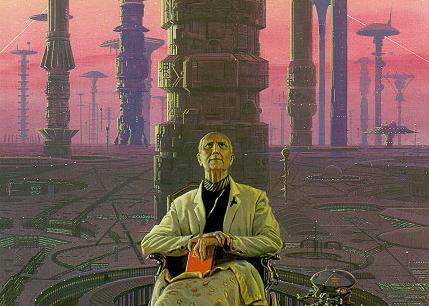 I first became conscious of Isaac Asimov when I was eleven or twelve, searching through the library catalogs for Star Wars novels. I must have been searching under the subject "science fiction" because Asimov's name came up again and again, to the point that I began to get irritated with him for clogging up my Star Wars search. In my head, I pronounced his name "Ayes-mov" and had not the slightest inclination to read anything he'd ever written.
For a few years now, however, I've been meaning to try some Asimov, and I'd heard Foundation was the place to start (maybe I shouldn't have started here, but one has to start somewhere, right?). And if I'm fair, though I have other Asimov books on my reading list, after Foundation, I'm not sure I really care enough to try anything else Asimov has written.
Foundation is like a summary of a historical epoch, spanning 150 years, occasionally dipping down to sample the specific characters and events that shape the history, but for the most part skimming the surface in the service of showing broader and more comprehensive themes. The novel begins with a sketch of the character Hari Seldon, who will become the seminal figure in Foundation, referenced like a god or a prophet, and details how Seldon, using his scientific discipline, psychohistory (a mixture of sociology, psychology, and economics in the service of old-fashioned fortune telling), manages to establish a colony on the edge of the galaxy, far from the center of the Empire, in the service of lessening the barbaric results of the Empire's inevitable decline.
A mouthful, yes? As soon as you've grasped that concept, Asimov skips you ahead fifty years and details the first of the "Seldon crises" as they come to be known - fore-told political crises that the established colony (the "Foundation") must face and overcome in order for the proper historical timeline (that Seldon mapped for 1,000 years into the future) to be followed. And once you've really gotten to know the characters involved in that particular crisis, Asimov once again skips forward in time, and so on throughout the course of the book.
Asimov has an odd style: talky, philosophic, and exhaustively expositive. I'm accustomed to broadly categorizing novels as either plot-based or character-based, but I'm not sure Foundation is either. Rather, it seems to be concerned primarily with the broad arcs of political and sociological change, which makes it unlike any other novel I've read but also makes it a little tiresome. Asimov teases us with characters that evoke depth and relatability, yet he never leaves them around long enough for us to fully connect, nor for them to become fully realized. He imagines situations that promise menace and suspense, and yet somehow each once is solved through wordy confrontations and whiffy capitulations.
Perhaps the main reason why Foundation fails to connect is the overriding psychohistory of it all. Its culture (and major characters) operate on a historical timeline that has been predicted 1,000 years into the future; because of this pervasive inevitability, it's difficult to muster any real sense of danger or tension. It doesn't help that Asimov's litany of powerful political figures who help confront and resolve the Seldon crises all operate within this same attitude of predestination - they all move one step ahead of their opponents, which means the book is littered with speeches wherein the characters unveil their foreknowledge and how they have, consequently, crushed their opponents' plans. It also means that, once we pick up on this propensity, we have no fear that any of the major characters are going to have anything surprising happen to them. Honestly, it makes for a dull read.
The characters, worlds, and situations Asimov imagines are tantalizing, and the philosophy that runs beneath all of it is suitably brainy and theoretical - yet the sum of the parts doesn't make much of a whole. I kept wishing he had made them all into a very different novel.
August 25, 2009
Fire to Fire - Mark Doty

Lord knows, I love Mark Doty. He's one of my favorite writers, as both a poet and memoirist - he does things with words and themes that make my gut clench and my "wow" reflex pump into overdrive. And, for me, that's what poetry is about, at its deepest, most elemental core: establishing a visceral connection with a reader, pulling the reader inside a poem with nearly terrifying momentum. Doty does that to me more than almost any other contemporary poet.
I went to the bookstore looking for one of his memoirs I hadn't read but instead came away with Fire to Fire, his 2008 collection of new and collected poetry. Since the only collection of his poems I own is My Alexandria, I figured Fire to Fire would be a nice addition to the shelf and also a way to view his twenty year career retrospectively. The volume is organized with his new work first, then skips back to the beginning of his career in the late 1980's and follows his succession of volumes published up through the 1990's. In this way, it's very easy to compare most recent Doty with earliest Doty, as they fall next to each other in the organization of the volume. As must be the case with most artists, the differences are are both surprising and revealing.
My familiarity with Doty's poetry is admittedly rooted in his earlier work, when he was considered an "AIDS poet" (and I suppose still has that reputation). It must be difficult, now that I think of it, to spend your entire career laboring (and trying to live up to) a definition created in your younger days and which is in some ways no longer relevant. Though the American AIDS crisis is no less tragic now than it was in the 1980's, it's less immediate. Its definition has changed, as have its voices. Reading a recent Doty poem about the ravages of AIDS would be like watching a recent production of Rent, and Doty understands that. He is no longer the "AIDS poet," and his new poems reflect a quieter, less outraged Doty, one who has settled into contented domestic bliss but who still has a keen eye for observing the world around him.
Take, for instance, "Apparition," in which Doty describes a peacock named "Hommer" at a garden center - he relies on his knack for writing birds, asking, "is the peahen/that hard to attract,/requiring an arc of nervous gleams,/a hundred shining animals/symmetrically peering/from the dim/primeval woods?" And yet, despite the shimmering beauty of his language, Doty ends the poem with a cute wink that seems a bit too characteristic these days: "And then the epic/trombone-slide-from-Mars cry/no human throat can mime/--is that why it stops the heart?--/just before he condescends to unfurl/the archaic poem of his tail." The man writes damn good animal poetry these days, but he has a tendency, as in this case, to spoil it with a neatness that doesn't suit.
It's this new(ish) tone that left me a little disappointed. His poems are clearly still quite beautiful, quite well-observed, still containing that spark of immediacy and contemporaneousness that makes his earlier work so jarring, and yet Doty is no longer interested in shaking us out of our suburban, traditional, middle class malaise - in fact, one might argue that he has in some respects become the person he once tried to awaken. Drenched with scenes from his NYC island, Doty's poems are finished with the sheen of well-fed, well-lived upper-middle-class city-dwelling liberal placidity. Does that sound too harsh for a poet I still love very deeply? Perhaps it's only because I wish I were at that place and had found the measure of peace he seems to have found in his life... perhaps it's that my affection for him (my desire for his well-being) pushes me to excuse the limpness of his recent verse. Whatever the reason, I can't bring myself to dislike his new poems, despite their shortfalls.
Maybe the real reason is that I have his searing early verse to look forward to when I finish Fire to Fire's initial segment, selections from his first volume, Turtle, Swan, which includes the titular poem, a lyric piece with gorgeous descriptions of the animals, ending with this verse:
I only know that I do not want you
--you with your white and muscular wings
that rise and ripple beneath or above me
your magnificent neck, eyes the deep mottled autumnal colors
of polished tortoise--I do not want you ever to die.
It's in poems like these that Doty marries his facility with language to the deep, unerring themes in his early work of love and, more presently, death. These themes are evoked throughout the selections from his earlier volume, including the beautiful "Tiara," from Bethlehem in Broad Daylight, and "Grosse Fugue" from Atlantis.
Through it all, though, as I trace my way through the timeline of his oeuvre, I am waiting for, comparing all poems to his magnum opus, "Atlantis," one of the great poems of the last fifty years and one of the timeliest of the twentieth century, in which Doty marries his lyric and elegiac tones so seamlessly, evoking not only the poignant beauty of his surroundings but also the hollow specter of a disease that affected his life so acutely. A long poem in six parts, "Atlantis" appears at first glance to be a rambling meditation but is in fact a tightly controlled exploration of a slow death, utilizing Doty's usual arsenal, as well as a persistent dream narrative and his penchant for grappling with the body/spirit dichotomy. In section three, a friend describes a dream:
Michael writes to tell me his dream:
I was helping Randy out of bed,
supporting him on one side
with another friend on the other,
I was helping Randy out of bed,
supporting him on one side
with another friend on the other,
and as we stood him up, he stepped out
of the body I was holding and became
a shining body, brilliant light
held in the form I first knew him in.
This is what I imagine will happen,
the spirit’s release.
when we support our friends,
one of us on either side, our arms
under the man or woman’s arms,
what is it we’re holding? Vessel,
shadow, hurrying light? All those years
I made love to a man without thinking
how little his body had to do with me;
now, diminished, he’s never been so plainly
himself—remote and unguarded,
an otherness I can’t know
the first thing about. I said,
You need to drink more water
or you’re going to turn into
an old dry leaf. And he said,
Maybe I want to be an old leaf.
In the dream Randy’s leaping into
the future, and still here; Michael’s holding him
and releasing at once. Just as Steve’s
holding Jerry, though he’s already gone,
Marie holding John, gone, Maggie holding
her John, gone, Carlos and Darren
holding another Michael, gone,
and I’m holding Wally, who’s going.
Where isn’t the question,
though we think it is;
we don’t even know where the living are,
in this raddled and unraveling “here.”
What is the body? Rain on a window,
a clear movement over whose gaze?
Husk, leaf, little boat of paper
and wood to mark the speed of the stream?
Randy and Jerry, Michael and Wally
and John: lucky we don’t have to know
what something is in order to hold it.
"Atlantis" is quintessential, perfect Doty... the form with which I will compare all other Doty poems. It's not his fault that he wrote his best work ten years ago, nor that I consider it his best work. What's lovely about Fire to Fire is that the volume pulls it all together - the pretty, the honest, and the gut-wrenching - and provides a nice platform from which to view the career of a poet who has been, and remains, an important voice in contemporary poetry.
August 24, 2009
Where the Wild Things Are - Maurice Sendak, Spike Jonze, Dave Eggers
 So, the news is that Dave Eggers is publishing a novelization of Where the Wild Things Are, based on his screenplay for the movie and, of course, Maurice Sendak's original concept. A taste of the novel, "Max at Sea," is published in last week's New Yorker and, truth be told, left me confused as to how on earth this novel, based on a screenplay based on a children's book, will even work.
I've never been one of Dave Eggers' legion of fans. I've followed his career more by happenstance than anything else - happened upon A Heartbreaking Work of Staggering Genius when it first came out (enjoyed it but have no enduring memories of it), happened upon the cult of his following in successive years, happened to resist and resent the adulation he seemed to inspire in the generation preceding me (perhaps one of the reasons I've never been able to jump fully on the Eggers bandwagon), and, most recently, happened upon Away We Go, for which he wrote the screenplay with his partner, Vendela Vida, and happened to find it one of the best films of the year so far. And now Eggers has entwined his destiny with that of Wild Things, so I have to grant him some good will.
Even so, it strikes me that only a particular kind of hubris would attempt a serious novelization of Wild Things, particularly after it's already been worked into a movie (one that promises to be as inventive and entertaining as the original children's book). It's a classic case of not knowing where to stop, of stretching a good idea too far and too thin, to the point that it begins to show wear and tear. One must ask of a novelization: what more will it add to the concept? Atop the picture book and the film, how will it deepen and expand the story? These are the questions I had as I came to Eggers' piece in The New Yorker.
Those questions weren't sufficiently answered, but they were quickly replaced by other, more urgent ones. In a novel of this type (documenting a story with such a long and auspicious history), what should be the tone? The point of view? Who is the audience?--that is, does Eggers expect to reach children, nostalgic adults, or both? To his credit, Eggers does manage to capture the frustration of a pre-teen boy rather well, and his characterizations (or rather, caricatures) of Max's mother, sister, and mother's "chinless" boyfriend are deft and amusing. The tone is more inscrutable, and the intended audience obscure. It seemed a piece perfectly suited to a young audience, and yet the novel promises a length and depth that might be challenging for children (though, given Harry Potter, perhaps our literate youth are far more up to that challenge than we think).
Most confusing of all, the piece neither seemed suited for an "excerpt" (not much of an arc), nor held promise of a rich story. In other words, there was too little arc for a short piece (a la New Yorker) and far too much arc to be a feasible section of a novel. Too much happens in this one piece: Eggers expands on the picture book but not by much, which left me wondering what purpose this excerpt will serve in the novel, how much novel will far before and after it, and if it's merely a bit of publicity for the upcoming film (and novel) and is in no way reflective of the actual arc of the novel.
A book like this--having a child narrator and yet still appealing to adults--can be done, and it can be done well. (The Neverending Story strikes me as a particularly analogous example.) In this excerpt, however, Eggers retains too much of the World and not enough of the Magic, sticking almost slavishly to Sendak's depictions of the Wild Things and forgoing his own license to create. I might still buy the book (and if so, I suppose this preview piece will have had its intended effect and render my current opinions moot), but I fear it will be an Eggers product that happens, this time, to disappoint.
August 12, 2009
The People of Paper - Salvador Plascencia

Little Merced. Frederico de la Fe. Saturn. Baby Nostradamus. Merced de Papel. Cameroon. Smiley. Froggy. Mechanical Tortoise. I could go on, listing the seemingly endless stream of characters that crop up in Salvador Plascencia's debut novel, The People of Paper, but it wouldn't be worth it. In the end, they all sort of blend together. It's a short book, but it takes a long time to read, sifting through a fragmented story that jumps from Mexico to Southern California to Niagara Falls to New York to Europe, and that encompasses at least twice as many characters as those listed above. A man moves his daughter from Mexico to El Monte, a flower-growing town of immigrants in Southern California, where he wages war on an unseeable, unknowable foe, shielding himself and his gang in lead houses and mourning the loss of his wife. This war trundles the novel along and provides a tentative arc on which Plascencia hangs his many and varied digressions, which include tales of lovers (and ex-lovers), of Catholic mysticism, of creation and destruction. It's a veritable pastiche of a book, and so very earnest that it's hard to dismiss outright.
Plascencia's novel is not brilliant, but it tries to be. It's not much of a novel either, though it tries to be that as well. Instead, it's an undisciplined, post-modern ramble of a book, indebted to Marquez, Borges, and Pirandello, and more than a little derivative of all three. It contains moments of beauty, and also wells of authenticity, deep pores of sadness that you feel through the pages. Plascencia writes with intuitive abandonment, leaping through points of view like a gazelle, as if afraid to light on any for too long, for fear that the delicate shards of his prose will crumble under the weight of living, breathing characters. He employs a great many post-modern tropes - non-linearity, meta-narrative, typographic experimentation - as if tasting for just the right flavor, but he never really commits to any.
Plascencia's novel is not brilliant, but it tries to be. It's not much of a novel either, though it tries to be that as well. Instead, it's an undisciplined, post-modern ramble of a book, indebted to Marquez, Borges, and Pirandello, and more than a little derivative of all three. It contains moments of beauty, and also wells of authenticity, deep pores of sadness that you feel through the pages. Plascencia writes with intuitive abandonment, leaping through points of view like a gazelle, as if afraid to light on any for too long, for fear that the delicate shards of his prose will crumble under the weight of living, breathing characters. He employs a great many post-modern tropes - non-linearity, meta-narrative, typographic experimentation - as if tasting for just the right flavor, but he never really commits to any.
A wise (but not very nice) man told me once that good poetry should be "difficult, but not obscure." The same should be said of the post-modern novel; unfortunately, all too many of them rely on obscurity to assure their reputations as masterpieces. When you peel back the trope and gimmick and wordplay, as with The People of Paper, what is left is often the quivering soul of a novel - a soul that has the potential for brilliance, transcendence, and permanence but without the muscle to will itself into being. The ideas are all there; the talent and the artistry is there as well; yet diffused through so much fragmentation, they have little effect or resonance.
That's not to say that The People of Paper is a novel (purportedly) banged out in a flurry of inspiration like a Kerouac or a Faulkner (bullshit on both counts, by the way), even though it has that effect. Rather, it occasionally reads like the tediously crafted drafts one sees in writer's workshops - those revolutionary, experimental, deeply felt submissions that reek of hours spent finding the perfect sentence. While there's nothing wrong with writing either by inspiration or by elbow-grease, relying too heavily on either contains dangerous pit-falls, and somehow The People of Paper manages to evoke the negative side-effects of both extremes.
Listen, The People of Paper is not a bad novel, nor am I surprised by its publication or its accolades. This might be a case in which I am simply the wrong audience for such a novel and that, in failing to grasp or appreciate its scope, my criticism is invalid. After all, Plasencia has written a quintessentially post-modern novel - why, then, should it be subject to the rules of traditional criticism? Nevertheless, I left it baffled and more than a little unfulfilled: blinded momentarily by its emotional affect, occasionally captivated by its verbal prowess, but ultimately left with the sense that I've just experienced a monumental exercise and that the real novel, the true novel - the one that makes full use of Plascencia's undeniable talent - has yet to be written.
August 11, 2009
My Life in France - Julia Child
 A few weeks ago, I enjoyed a weekend with Julie Powell's memoir, Julie and Julia, which got me excited to see the movie (released this weekend, but I'm waiting to see it with Dan). When I read the book, however, I was disappointed that it didn't include more about Julia Child's life, as the movie seems to do. Come to find out, the movie is in fact based on both Julie and Julie AND Julia Child's memoir, My Life in France, which I picked up on Saturday and spent the weekend reading.
That, coupled with last week's viewing of a few French Chef episodes PBS kindly put on their website, has convinced me that Julia Child was one of the most endearing personalities of the last century, and led one of the most delicious, joy-filled lives. Granted, I learned as a young, young person that the memoir is not necessarily the best rubric for developing an objective opinion of someone's life and work (see Inside the Third Reich by Albert Speer); however, Child's memoir is filled with such effervescence and ebullience, it's impossible to believe that she was anything but the way she describes herself: loud, funny, mawkish, curious, pugnacious, irreverent, and unrelenting. She was, on television and in the pages of her book, a larger than life character, someone who attacked projects with an enviable vigor and who really enjoyed living.
I guess I expected that. What I didn't expect when I picked up her book was the effortlessness of reading it, the uncluttered, unfussy, often very funny prose (granted, she had a co-writer, Alex Prud'homme), and the deep love for France and for her friends and family that emanates from the pages. Child also had either a prodigious memory or kept copious records of her life, for when she describes memorable meals (as she does often and with great delight), she does so in the meticulous detail of someone for whom those meals made a lasting, indelible impression.
I was also delighted to read about her relationship with her husband, Paul Child, ten years her senior, and a so-called "exhibits man" for the United States government. It was his job that took them first to Paris, then to Marseille, and eventually to Germany and Norway, and its his presence in the book that really grounds it. Julia doesn't waste time or poetry lyricizing about her husband, but her deep affection for him and his for her really permeates the pages. While wading through a culture and media that insist that all romantic relationships be comprised of fire and ice, of passion, deceit, and heartbreak, it's refreshing to occasionally come across a record of a marriage based on mutual support, affection, and respect. Though one gets the feeling the Childs' relationship wasn't one of shooting stars or roses, necessarily, it certainly appeared to be a loving partnership, filled with humor and grace.
And that's really the book in a nutshell: humorous and graceful, an easy read, and a delightful one. While the derivative, Julie and Julia, was a confection, My Life in France is like Child's famous boeuf bourguignon: warm and filling, something that will stick to your ribs after a very long day.
Subscribe to:
Posts (Atom)